
2026-06-02
The Real Cost of Building for Someone Else
I've been a builder my whole career. Shipping products is the part I love — the part that feels natural.
So when a few people in my circle asked if I could help them build their ideas, I said yes without thinking much about it. I know how to code. I know how products work. How hard could it be?
Turns out, the hardest part wasn't the code.

Communication is the actual bottleneck
Building for yourself is simple. The product manager and the engineer are the same person. Decisions happen in your head instantly. Pivots cost nothing.
Building for someone else is a completely different game.
What I discovered — and what nobody really talks about — is that the development time is almost never the bottleneck. The bottleneck is everything that happens before a single line of code gets written. Figuring out what they actually want. Translating vague ideas into concrete requirements. Iterating on wireframes. Getting alignment on scope. Handling the "oh, I forgot to mention" moments that surface after you've already built the thing.
In one project, I spent maybe 12 hours actually coding. I spent 3x that in back-and-forth messages, calls, screen shares, and revised documents.
That ratio felt wrong. And inefficient. And expensive — for both sides.
The realization
If communication is the dominant cost, then the right solution isn't to hire faster developers. It's to radically compress the communication phase.
And if most products share a common set of building blocks — authentication, reservations, payments, notifications, admin dashboards, catalogs, chat — then the development phase can be compressed too. Not by cutting corners, but by having pre-built, production-ready modules that already know how to talk to each other.
Put those two things together and you get a very different kind of service. One where a client could go from "I have an idea" to a live, deployed product in 6 hours.
That became the product I'm now building.
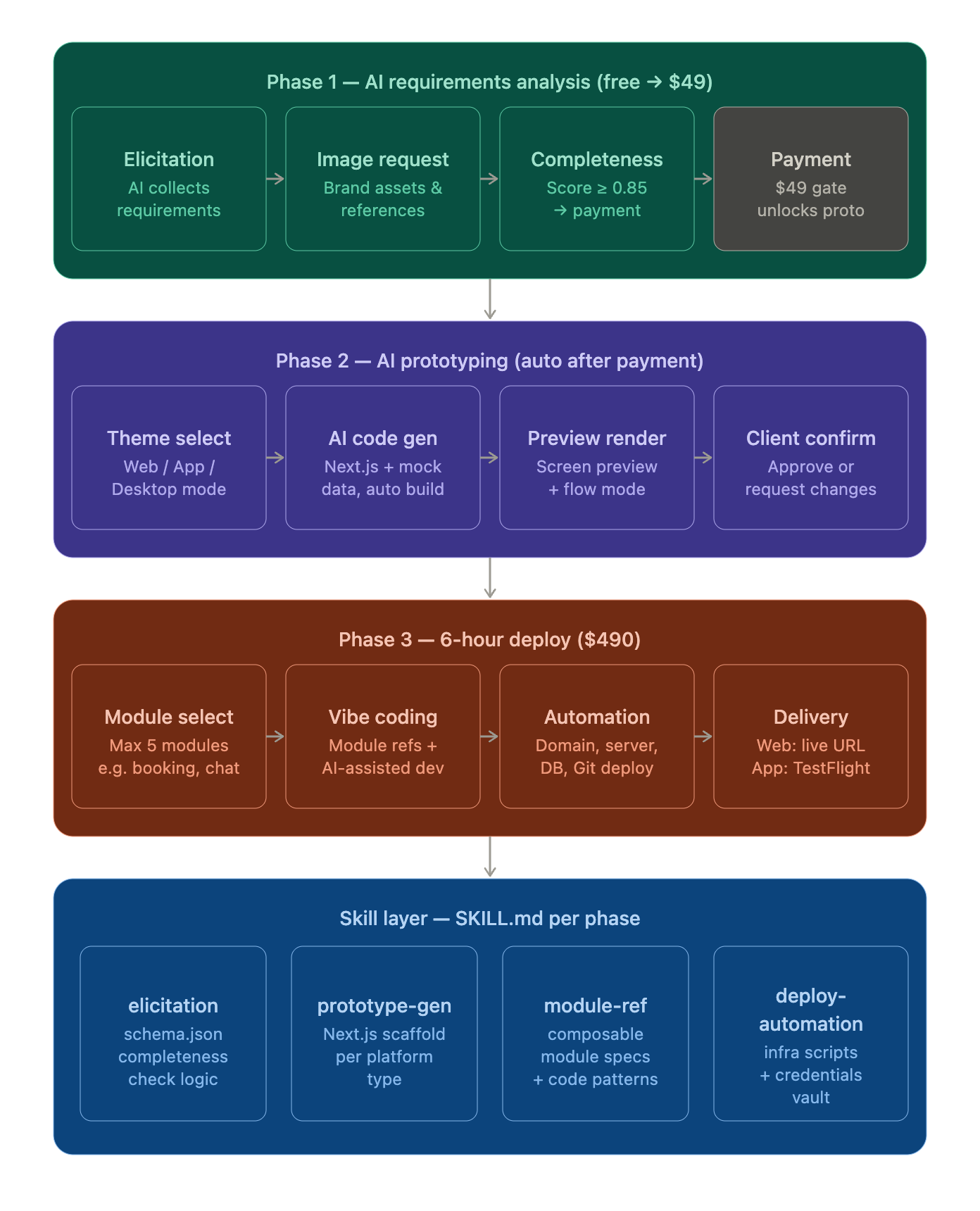
How it works
The first phase is AI-driven requirements analysis. A client talks to an AI that does what I used to do manually — asking the right questions, in the right order, until the full picture is clear. What do you need? Who's it for? What does success look like? What's definitely out of scope? What references inspire you?
The AI doesn't move on until the requirements are actually complete. Not just answered — complete. It even asks for brand images, reference screenshots, style preferences. All the things that normally show up in week three of a project, when you're already deep in implementation.
When the AI is confident it has enough to work with, the client pays a small fee (₩49,000 / $49). That fee is the gate to the next phase.
After payment, an AI prototype gets built automatically. The client sees real screens — not static mockups, but interactive Next.js pages with realistic mock data. A flow view shows how the screens connect. The client confirms or requests changes. All before a human developer has touched anything.
Only after that confirmation does a developer get assigned. They have the requirements doc, the prototype, and access to a library of pre-built modules. They pick the modules that fit — maximum five, which is the constraint that makes the 6-hour guarantee possible — and build outward from there.
When the build is done, deployment is fully automated. Domain, server, database, GitHub, admin panel — all wired up programmatically. For mobile apps, TestFlight too.
Six hours from kickoff to a live URL.
Why the module constraint actually matters
The 5-module limit isn't a product limitation. It's the mechanism that makes the whole thing work.
Every feature you add to a software project doesn't just add linear cost — it adds combinatorial complexity. Two features can interact. Three features can conflict. Five features that haven't been designed to work together can consume an entire sprint just in integration work.
Pre-built modules that are designed to compose cleanly eliminate most of that. A reservation module that already knows how to talk to a notification module. An auth module that every other module already expects to be present. The hard integration work gets done once, not on every client project.
That's the real leverage point. The 6-hour timeline is the outcome. The modules are the reason it's possible.
What I'm building first
The launch version focuses entirely on Phase 1 — the AI requirements analysis.
This is the part that has to work before any of the rest matters. If the AI can't extract a genuinely complete, unambiguous set of requirements from a client conversation, the prototype will be wrong and the development phase will balloon back into the chaos I'm trying to eliminate.
So that's where I'm starting. Getting the elicitation loop exactly right. Building the schema that captures what "complete requirements" actually means for different product types. Training the AI to know the difference between "I understand your idea" and "I have everything I need to build it."
The 6-hour deploy comes later. But it only works if phase one is airtight.
More updates as this develops.