
2026-05-28
Building VibeTalk: A Translation App That Actually Understands Relationships
I've spent the last 12 months living between Da Nang and Chiang Mai. Coffee shops, co-working spaces, street food stalls, motorbike rentals, landlord negotiations — the full digital nomad circuit. And the whole time, I kept running into the same problem.
Google Translate would give me technically correct words. But I'd hand my phone to a shop owner in Chiang Mai and she'd laugh — not unkindly, but the way you laugh when someone accidentally uses the most formal possible version of "can I have a bag." And then in Da Nang I'd be texting someone I was dating, running phrases through a translation app, and the output was so sterile it might as well have been a government form.
The words were right. The relationship was completely missing.
That's the thing about Thai and Vietnamese especially — the language is the relationship. Who you're talking to determines the pronouns, the sentence endings, the entire register. Anh or em. Krub or na. These aren't stylistic choices. They're how you signal respect, familiarity, affection. Get it wrong and you're not just awkward — you're kind of rude without knowing it.
Every translation app I tried treated language as a one-size-fits-all problem. So I decided to build one that doesn't.
The idea
The core concept is simple: before you translate anything, you tell the app who you're talking to.
A stranger at immigration. The lady who runs the café you go to every morning. Your landlord. Someone you're seeing. Each of these people deserves a different version of you — and the app should know that.
I'm calling it VibeTalk for now. Working title. The actual name will come later, probably after I've stared at it long enough to hate it and then come back around.
The relationship types differ by country, which is important. Thailand isn't Vietnam isn't Bali. In Thailand the formal/informal split is about particles and politeness levels. In Vietnam it's almost entirely about pronouns — the whole anh/em/chị/bạn system is doing enormous social work in every sentence. In Indonesia/Bali the context is different again, especially for the digital nomad use case where you're constantly in negotiation situations — villas, drivers, tours — where tone matters a lot.
So the app launches with three countries: Thailand, Vietnam, Indonesia. Each with their own set of relationship presets. You pick your target country, you pick who you're talking to, and the AI translates with that context baked in.
Why I'm building it solo
I'm a solo founder. Have been for a while now. The honest answer to "why solo" is that I've been living out of a backpack across Southeast Asia for the past year and the idea came from lived experience — not from a brainstorm session or a market analysis deck.
I know this user. I am this user. That's usually where the best product ideas come from.
The tech stack is Flutter for iOS first, speech_to_text for voice via Apple's built-in speech framework, and Claude/GPT-4o-mini for the actual translation. The AI prompt is where the real work is — getting the model to understand not just the words but the register, the relationship, the social context. That's the hard part and also the interesting part.
What I designed this week
After sketching the idea out in full, I moved straight to screen design. Four core screens:
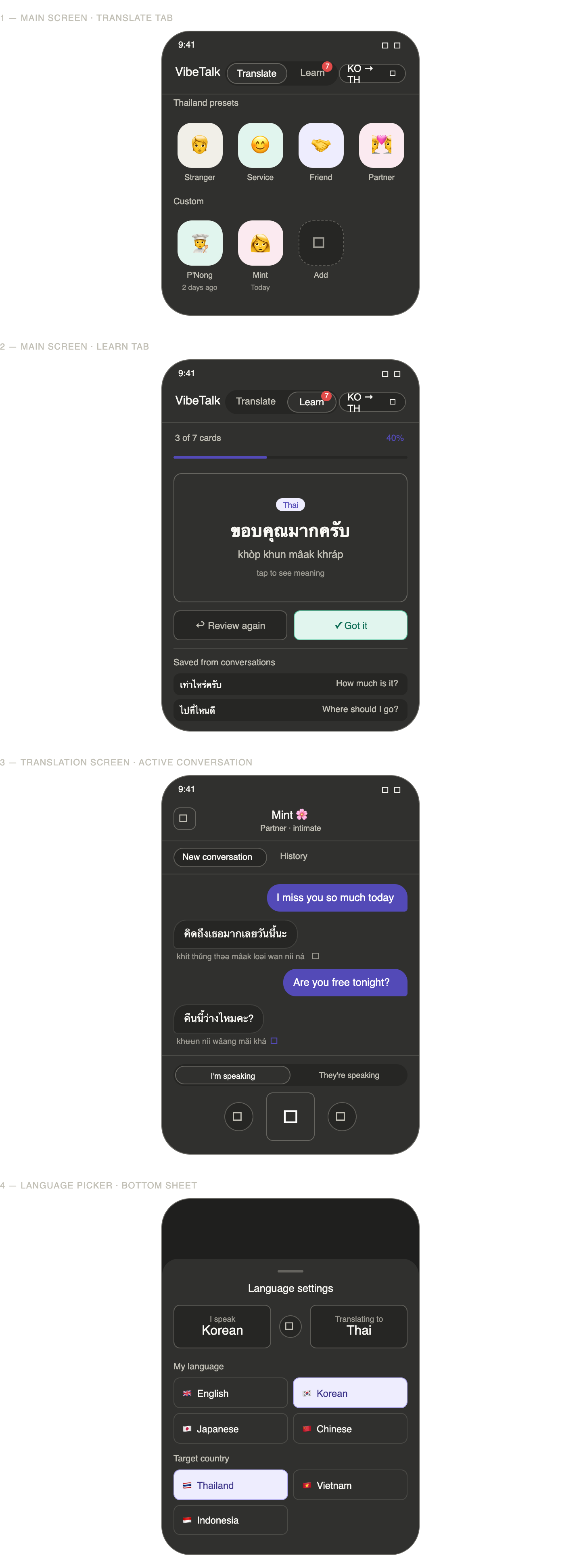
Main screen — a character grid. You see your relationship types as avatar cards. Tap one and you're in. The header has a Translate / Learn tab toggle — more on Learn in a second.
Translation screen — it opens with the mic already active. You talk, it translates, the result appears as a chat bubble with pronunciation shown below. There's a direction toggle at the bottom so you can flip to "they're speaking" mode and hand the phone over. Bidirectional in one tap.
Learn tab — every translated phrase has a small bookmark icon. Tap it and it saves to a flashcard. The Learn tab shows a red number badge when you have cards waiting. It's a simple flip-card UI — see the phrase, tap to reveal the meaning, swipe got it or review again. Nothing fancy. The learning feature is a side dish, not the main course.
Language picker — a bottom sheet where you choose your native language and target country. Changing the country reshuffles the character grid to match that culture's relationship presets.
The thing I keep thinking about
There's a version of this app that's just a translation tool. Useful, fine, forgettable.
And then there's a version where your custom characters start to actually know things. The context of your conversations accumulates. The app remembers that with P'Nong at the coffee shop you're always joking around, and with your landlord you keep things formal. The translation starts to feel less like a tool and more like a social layer — one that's been paying attention.
That's Phase 4 on my roadmap. But it's the version I'm actually building toward.
Next
This week I start writing code. Flutter project, folder structure, data models. I'm treating this the same way I've treated every product I've shipped — validate the core loop first, build outward from there.
The core loop here is: pick a character → speak → get a contextually appropriate translation. If that works and feels right, everything else is secondary.
More updates as I build. If you're a nomad in Southeast Asia and this sounds like something you'd actually use, I'd genuinely love to hear from you.